We are long AMTX, GEVO shares. This article does not constitute investment or trade advice. We share our analysis, opinions, and the predictive output of our AI Advisory model as documentation for our own investing decisions, which might turn out to be underperforming the market. Micro-caps are volatile investments. Complete loss of capital is a possibility.
Trade
Long Aemetis $AMTX
Date: 5/9/2025
Symbol: AMTX
Order: BUY
Entry Price: $1.29
Position size: Full
Time horizon: 5 years+
Price Target
1-year target (2026): $8.5 (+650%)
5-year target (2030): $29 (+2200%)
Summary
Aemetis is an undervalued microcap with products in rising demand, and a potential near-monopoly in California's Central Valley and strong growth prospects in India.
There are strong supporting trends: the climate is warming up, and renewable fuels for trucks, planes, and households will take off.
The Trump Administration may not be the setback people think.
Execution of the 5-year plan is key for a 20x+ return, and we analyze various risks.
Our investing approach: We look for emerging and secular trends and then research assets we think can be big winners in those trends. Ideally, those companies are mispriced, misunderstood, and under-followed. We also use technical analysis and our AI models to optimize our entries, with the goal of generating significant alpha over a long-term holding period (5 years+).
Climate Change and Renewable Fuels Trends
The climate change and global warming trend has been a secular trend for decades, whether some disagree that they are caused by humans or not.
There is an ongoing effort from various countries to reduce the emissions of greenhouse gases to reduce global warming.
One of the solutions is the use of low-intensity to negative-carbon intensity fuels for trucks and for the aviation industry, the latter being responsible for 5% of carbon emissions. Carbon capture is also another emerging technology, but not without its share of controversies, however.
We seek investments that could do very well in a rising trend and generate tremendous alpha.
Supporting trends
Climate change and global warming – rising temperatures will continue to affect governance and policies around the world
Renewable Fuels – increasing demand as EV planes and trucks are not viable in the short and medium term.
Carbon Capture – increasing interest, by many oil majors and major companies in other sectors.
Biocircular economy – allows US farmers to make use of the agricultural waste.
Rising Energy demand – supported by other secular trends such as Automation and AI, and global US-China competition.
Energy independence policies in the US have bipartisan support.
Energy redundancy policies in India also have strong political support.
Opposing trends
Rise of populism, which will affect governance and policies as a counter-trend.
While there is a wall of worry about the new Trump administration being a climate-change skeptic, we cover in the following section why we don’t view it as breaking the thesis.
Aemetis The Bull Thesis
Aemetis is a microcap located in California and headquartered in Cupertino. The company is building plants and facilities for various products that will be increasing in demand in this decade, given the above supportive trends.
Dairy Renewable gas (RNG) – One of the lowest-carbon alternative fuels. Project to build and operate biomethane digesters at 75+ dairy farms in CA.
California Ethanol – Own and operate a 65 mgy renewable ethanol production facility in Keyes, CA.
Sustainable Aviation Fuel (SAF) – Plan to build a plant in CA with 78 mgy of capacity. Permit acquired, waiting for financing.
India Biodiesel – Own and operate a 60 mgy biodiesel plant in Kakinada, India. Plans to expand to 100 mgy in 2025.
Carbon Capture – Project to capture, dehydrate, compress, and sequester CO2 from Aemetis ethanol, biogas, SAF/RD, and third parties.
Many of these business segments work synergistically together and offer both business and geographical diversification.
Aemetis is advancing toward a strong presence for the dairy renewable gas in California's Central Valley, securing 35-year lease contracts with multiple dairies and building 60+ miles of pipeline interconnecting the dairy digesters. Over the years, all the infrastructure being built, the permitting, and the dairies' long-term contracts constitute strong barriers to entry for any new incumbent.
Their subsidiary Universal Biofuels is one of the largest biodiesel producers in India. India doesn’t have natural oil resources, and being able to produce biofuels is critical and is supported politically. India is also one of the fastest-growing economies, with a vibrant stock market where IPOs are often oversubscribed by retail investors.
The management has issued a 5-year plan in 2023, with expected revenues of $1,959M and $645M EBITDA in 2028. That would represent a 38% CAGR revenue increase and a 20x EBIDTA increase from 2024 numbers.
At ~$70M market cap at today’s share price, the realization of their 5-year plan has the potential to bring the market valuation to $2-5B, implying at least a 20X increase (1900% returns) from the current share price of $1.29.
Given the current extremely low valuation and the short-selling volume, the market is skeptical about the potential of Aemetis executing its plan and achieving profitability.
The crux of the Aemetis bull thesis thus resides in assessing whether the plan could come to fruition, even if with some delay, and if that probability makes the risk-reward worth it.
In this article, we will weigh all the factors that could explain the market's skepticism.
Politics and the Trump Administration implications
Let’s talk about politics first, as we think this is one of the top fears for many investors, not only for Aemetis but for the so-called “green industry”.
On Biofuels and RNG
The election of Donald Trump in 2024, who is not known for being a pro-climate supporter, has had many people question the viability of various sustainability investments.
It’s important to understand that Aemetis is a renewable energy company, and the keyword is “energy”. Energy independence is an American bipartisan issue.
Donald Trump signed on January 20, 2025 an executive order “Unleash the American Energy” which mentions “Renewable Biofuels” among other energy sources:
“The heads of all agencies shall review all existing regulations, orders, guidance documents, policies, settlements, consent orders, and any other agency actions (collectively, agency actions) to identify those agency actions that impose an undue burden on the identification, development, or use of domestic energy resources — with particular attention to oil, natural gas, coal, hydropower, biofuels, critical mineral, and nuclear energy resources” - President Donald Trump E.O.
It is worth noting that farmers have a beneficial relationship with biofuels and Renewable Natural Gas (RNG), primarily due to economic incentives and environmental policy alignment.
Approximately 40% of US corn goes into ethanol production. Farmers gain steady demand, stabilizing corn prices and boosting rural incomes.
Animal waste and agricultural residues are converted into methane. RNG provides farmers an additional revenue stream by selling gas into energy markets or receiving carbon credits.
European Union: Parliament approved an SAF mandate requiring fuel suppliers at EU airports to incorporate 2% SAF starting in 2025. That percentage will increase to 6% by 2030, 20% by 2035, and eventually 70% by 2050.
Japan intends to require a minimum of 10% SAF usage for international flights departing from its airports by 2030.
India has set an indicative SAF blending target of 1% by 2027, increasing to 2% by 2028, and 5% by 2030. The SAF targets will initially apply to international flights.
That means US airlines will have to comply with international SAF regulations if they want to fly internationally, whether the US government is supportive or not of a SAF mandate for airlines.
→ The SFO international airport, located in California, can become the key buyer of SAF from Aemetis.
On Carbon Capture
What is going to be the Carbon Removal Policy under Trump 2.0?
Carbon dioxide removal (CDR) has been enjoying bipartisan support due to its economic and agricultural benefits, with high potential in both red and blue states. The U.S. is already generating over 35% of all CDR jobs.
If we look at what the key fossil oil producers are doing, they are very much into Carbon Capture projects. Occidental Petroleum built the world’s largest Direct Air Capture project in Texas. Shell is pursuing carbon capture projects in the U.K., Canada, and Texas. Chevron is operating carbon sequestration facilities in Australia and California. BP is researching sequestration in Indiana. ExxonMobil operates a 1,500-mile network of CO2 pipelines for industrial use and storage with a completed well in East Texas.
It is not hard to understand that big oil producers want to use Carbon Capture technology to be able to extract and sell more oil from the ground. While this may not be in reality pro-environment, it has become a trend and likely will impact politics due to the economics.
All these approaches are very much in line with the “technology will solve climate change” narrative instead of “consumers or society will have to change”. This is very much in line with the market fundamentalists and the Silicon Valley techno-maximalist trends.
Regardless of one's opinion on the subject, this is supportive of the Aemetis Carbon Sequestration project.
California is likely to continue pushing its ambitious Green Agenda.
Aemetis operates mostly in California, with its network of dairies, farmers, and future potential buyers of SAF (e.g, the SFO international airport).
While political change is possible, California has outlined an ambitious environmental agenda for the next decade, aiming to achieve carbon neutrality by 2045.
Greenhouse Gas Emissions Reduction: Aim to cut emissions by 48% below 1990 levels by 2030, surpassing the statutory mandate of 40%.
Utilities like SoCalGas aim to replace approximately 12% of the traditional natural gas supplied to residential and small business customers with RNG by 2030.
California is actively promoting SAF to decarbonize the aviation sector. Assembly Bill 1322 mandates CARB to develop an incentives-based plan to increase SAF production and usage, targeting 20% SAF use by 2030.
India politics
India imports approximately 85% of its crude oil requirements. Expanding biofuel usage can significantly reduce this dependency.
Farmer Income: Biofuel production offers farmers additional income sources by utilizing surplus crops and agricultural residues.
We view these as tailwinds for Aemetis' Indian subsidiary, which is one of the largest producers of biofuel.
Weighing all the Risks
The 5-Year plan's main risks
Is the 5-year plan credible? What are the main fears and execution risks?
The Trump Administration's impact on the plan.
We’ve addressed the general political issues in depth in the section above.
Regulatory and Policy Risks
Aemetis's projects heavily rely on regulatory approvals and government incentives. Delays in obtaining Low Carbon Fuel Standard (LCFS) pathway approvals for dairy digesters can postpone revenue streams. Additionally, changes in federal or state policies, such as modifications to the Inflation Reduction Act (IRA) tax credits, could affect project economics and timelines.
Financing Risks
The execution of the five-year plan requires substantial capital investment, specifically to build the SAF plant and the new dairy digesters. The 5-year plan shows at least $400M of capex over 3 years for the SAF plant.
→ Aemetis has received approval from the USCIS for the sale of $200M EB-5 notes to foreign investors, which could help fund the SAF plant construction in the future, pending successful participation.
→ Aemetis could potentially have a financial deal with airlines for the SAF plant in the form of a joint venture.
The Debt Risk
For the Q4 2024, Aemetis stated $451.31M of outstanding debt on its balance. There are some concerns about the debt becoming unsustainable.
The debt is concentrated on a single lender, Third Eye Capital located in Canada. They have provided various forms of debt financing, including funding for initiatives such as the Carbon Zero 1 sustainable aviation fuel and renewable diesel plant, as well as upgrades to the Keyes ethanol plant.
Eric McAfee, Chairman and CEO of Aemetis, has maintained a longstanding financial relationship with Third Eye Capital and its CEO, Arif N. Bhalwani, since 2008. Third Eye Capital has been involved for over 17 years in several collaborative transactions (e.g. acquisition of the Goodland ethanol assets in Kansas) and debt financing. Through his firm McAfee Capital, he has pledged a significant portion of his personal assets as collateral to secure the loans.
→ While there is no certainty of continuous financing support from Third Eye Capital, an almost 2-decade relationship is very strong, and should be continuing, especially with Aemetis being on the verge of reaching an inflection point.
→ Aemetis could repay its outstanding debt in several ways.
The India subsidiary IPO could provide some liquidity (30-100m$) to repay some of the debt.
The sale of tax credits could also provide cash to alleviate the debt burden.
Profitability Fears – Will Aemetis reach Profitability?
Aemetis has historically operated at a net loss and has not reported a profitable year. This may scare some investors, especially since the company was founded in 2006.
→ Some of the company segments have already achieved positive adjusted EBITDA in certain periods. In the first quarter of 2024, both the India Biodiesel and Dairy RNG segments generated positive EBITDA. The India Biodiesel segment recognized $32.7 million in revenue, primarily from sales to India's Oil Marketing Companies. The Dairy RNG segment produced 60,300 MMBtu from eight operating dairy digesters and reported $3.8 million in revenue.
The India subsidiary is debt-free and cash-flow positive. The company internally funded its capacity expansion.
→ While not yet profitable as a whole, Aemetis has been building key infrastructure, with enterprise assets now possibly worth over 1B$. After most of the capital expenditures are done over the next few years to expand the dairies' RNG, build the SAF plant, and the carbon capture facilities, Aemetis could achieve strong positive EBITDA.
Delay fears
The 5-year plan could be delayed due to execution, financing hurdles, and regulatory and policy changes impacting the overall profitability and funding. Previous delays have frustrated investors.
The 5-year plan projected $387M in revenues in 2024, but Aemetis reported full-year revenue of $268 million for 2024. This is a miss of $119M on the plan. The revenue is still marking a 43% increase from $187 million in 2023.
→ The 5-year plan could be quite optimistic in terms of timeline, given the potential for financing and regulatory delays. Our base case is that there will be delays.
Other potential market fears
These other factors could contribute to the current undervaluation by the market participants.
General climate change investment skepticism
Climate change skepticism itself is relatively widespread in the U.S. It has decreased over recent years, but it has a strong partisan divide. We already talked about the impact of a Trump presidency on Aemetis.
Some investors could fear that some climate-themed investments, such as solar, biofuel, or carbon capture, are uninvestable.
→ We already explained that Aemetis is an energy play that also supports farmers, who receive bipartisan support.
Aemetis is located in California and India. California is a very pro-green solutions state.
If you believe, like us, that the climate change trend is real, the increasing visibility of climate impacts will gradually shift the public perception.
A generational shift is also at play, where younger generations show significantly less climate skepticism than older generations.
Finally, the rapid growth in renewable energy technologies, EVs, battery storage, and related green industries will reduce economic reliance on fossil fuels, lessening resistance from the former economic stakeholders.
But what about timing? Is an investment in Aemetis in 2025 too early?
→ We don’t know the future, but we know markets can bottom long before the economic fundamentals change. Political leaders and parties' support can change rapidly, but secular trends are here to stay.
And once a company reaches a critical inflection point, its valuation can be 10 to 50 fold more.
An Unknown Micro-cap
Aemetis is only covered by a few analysts, and the institutional ownership is pretty low at ~25%. This company is largely under the radar for large-scale investors.
As for retail investor engagement, we scanned various social networks, and the volume for Aemetis and $AMTX is very low.
→ We view the under-the-radar status for now as a positive. We want to be able to be early investors in a promising company and accumulate shares before a major inflection point.
Macro-Economic headwinds – a Recessionary Environment.
In 2025 or 2026, a recession could seem likely to many investors. It’s legitimate to be wary of investments, especially small-caps. Will the company survive?
→ We are in the camp that the US could enter a recession within the next 2 years, and is at risk of entering a long, protracted bear market. While this seems a significant headwind to our investment case, we think the company is already too cheap to pass on.
Even during bear and sideways markets, many companies can thrive, and we view Aemetis as a 5-year long-term investment with low beta to the SP500 and its own set of catalysts. We are fully expecting a volatile environment and large share price variations.
→ We are hedging some of our small-cap investments long with shorts on some indices (SPY, IWM) as a pair trade.
Complex Regulatory Environment
The complex credit incentive system can take time to understand. We provide some pointers below.
→ We view this as a positive, giving an edge to investors who spend time understanding the complex web of regulation around the company.
Too Many Moving Parts
With multiple business segments' profitability tied to an evolving regulatory and taxation policy, some investors may feel the company is in the “too hard to invest” bucket, as they may feel there are too many “unknown” variables.
→ The goal of this report is to shed some light on those moving parts. We want to find investments where the information asymmetry is high.
Short-Sellers' Attacks and Price Manipulations.
Aemetis is a quite heavily shorted stock, with ~17% of the float shorted as of 4/17/25 according to the Nasdaq. This represents 8M shares.
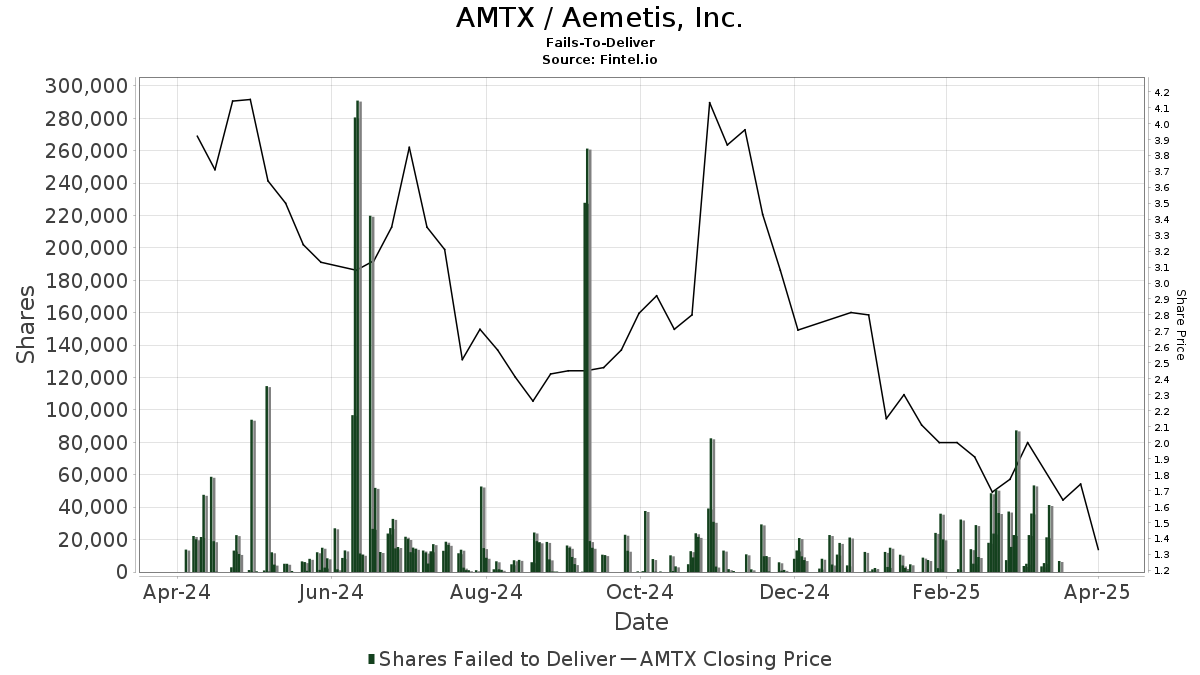
More concerning, there appears to be a lot of naked shorts. One of the tell-tale signs has been the Fails-To-Deliver volume. This may indicate some price suppression action by some entities for short-term profits.
→ Short sellers can be damaging to a small company, especially for a micro-cap like Aemetis. They can also enable a short squeeze, which provokes a rapid surge in share price, as short-sellers struggle to cover their shorts. There are probably few instances where Aemetis has already experienced a small short squeeze, such as on 5/1/23, where the share price went from $1.6 to $7+ in less than 30 days.
In our opinion, short sellers are playing a dangerous game with the stock price already near a 5-year low.
→ Future legislation against naked short selling could be a positive for the stock.
Distrust of the management.
Some investors may doubt that the management can execute on the 5-year plan timeline.
→ A review of Aemetis' management shows that the top leadership team has been with the company since the beginning. Eric McAfee founded the company in 2005, Andy Foster, the Executive Vice President, joined in 2006, and the CFO, Todd Waltz, joined in 2007.
Interestingly, its board of directors has people who have served in the private sector and the government. Lydia I. Beebe was an executive at Chevron, and Dr. Naomi L. Boness also worked for Chevron as a consultant.
John R. Block served as U.S. Secretary of Agriculture, providing deep insights into agricultural policy and regulation, while Timothy Simon was a former commissioner of the California Public Utilities Commission, overseeing utility regulations.
The fact that the board has oil energy industry veterans, as well as high governmental servants such as the former Secretary of Agriculture, is notable.
Diving deeper: Aemetis fundamentals
Most Aemetis have been covered on their 5-year plan here, and most material (CEO interviews, analyst picks, earnings calls) have been gathered on the Aemetis study board.
We encourage you to study those materials if you want to fully understand Aemetis as a company and the investment case. The same should apply to any other long-term investment.
Here are some pointers to dive deeper
The Production of Tax credits and their influence on profitability.
Credits are designed to accelerate the reduction of greenhouse gas emissions from the transportation sector. Aemetis is a beneficiary of multiple types of credit, which allow it to increase the value of its fuels.
California Low Carbon Fuel Standard (LCFS) credits.
Inflation Reduction Act (IRA) credits. Includes 45Z Production Tax Credit (PTC).
Renewable Identification Numbers (RIN) credits.
The California Air Resources Board (CARB) established the market for trading LCFS credit and regulates the prices. The goal is to push the usage of low-intensity fuel, without hurting existing consumers by too rapid price increases.
The lower the carbon intensity (CI) of the produced fuels, the higher the potential credits.
Catalyst:
→ Aemetis is waiting for approval by CARB for a Tier 1 pathway to CARB for its dairy RNG, with a carbon intensity score of -415. Currently approved for the default pathway of -150, Aemetis will receive 5x fewer credits than at a -415 CI.
The India Subsidiary IPO.
Aemetis management discussed doing an IPO for the India subsidiary, Universal Biofuel. The raised funds from the public market will help the biodiesel expansion to other locations and diversification into biogas production.
Rajputana Biodiesel, a much smaller company producing only 3M gallons of biodiesel, did an IPO last year, at a market cap of ~2B rupees or USD $23.7M.
Universal Biofuels has upgraded its production to 80M gallons of annual biodiesel production, with plans to reach 100M, and then 200M gallons post-IPO.
We estimate the IPO to value Universal Biofuels between $220M and $525M, depending on the Indian market and economic conditions at that time.
Catalyst:
→ The planned IPO for the end of 2025 or early 2026, according to the latest earnings calls, could help boost Aemetis' cash position.
Financial modeling
We use the revenues and adjusted EBITDA numbers provided by the management in their 5-year plan.
We then apply what we think are conservative EV/EBITDA multiples based on historical industry multiples, and estimate a potential Enterprise Value. That gives an estimate of $4.3B of EV in 2028. Planning for a 5% share dilution every year, and the debt, with a market cap north of $4B, we arrive at a potential share price of $58. Adding a discount rate of 50% for execution risks, we arrive at a target price of $29.
The year 2024 already showed a miss in terms of revenues, and we are viewing 2030 as a more conservative date instead of 2028 for our price target, which represents a 2,200% upside from today’s price.
Of course, Aemetis could also surprise to the upside.
At an actual $4B market cap, with less share dilution per year (2%), the share price ends up at $68, or a 5,300% upside. We prefer to remain conservative in our expectations given the delay risks.
2024
2025
2026
2027
2028
Revenues (millions)
386.3
579.2
1,100.3
1,602.8
1,958.0
California Ethanol
212.9
238.8
248.8
249.8
251.0
India Biodiesel
155.3
259.1
369.2
442.3
575.0
Dairy Renewable Natural Gas
18.1
81.3
144.2
181.2
190.0
Renewable Diesel & SAF
-
338.1
671.9
643.0
Carbon Capture & Sequestration
-
57.6
299.0
Adjusted EBITDA (millions)
31.3
142.1
309.2
486.0
644.6
California Ethanol
15.9
50.7
62.0
64.3
65.4
India Biodiesel
18.3
46.2
55.8
68.9
90.4
Dairy Renewable Natural Gas
7.0
55.3
104.1
129.1
122.6
Renewable Diesel & SAF
(0.7)
(0.8)
96.7
194.7
165.1
Carbon Capture & Sequestration
(0.1)
(0.1)
(0.1)
37.8
209.6
Corporate
(9.1)
(9.2)
(9.3)
(8.8)
(8.5)
Enterprise value
135.9
680.2
1,807.9
3,101.1
4,321.6
California Ethanol (5.0x)
79.5
253.5
310.0
321.5
327.0
India Biodiesel (5.0x)
91.5
231.0
279.0
344.5
452.0
Dairy Renewable Natural Gas (8.0x)
35.0
276.5
520.5
645.5
613.0
Renewable Diesel & SAF (8.0x)
(5.6)
(6.4)
773.6
1,557.6
1,320.8
Carbon Capture & Sequestration (8.0x)
(0.8)
(0.8)
(0.8)
302.4
1,676.8
Corporate (7.0x)
(63.7)
(73.6)
(74.4)
(70.4)
(68.0)
Debt
(451.3)
(600.0)
(800.0)
(700.0)
(600.0)
Cash
3.0
20.0
25.0
30.0
40.0
Marketcap (M)
109.8
100.2
1,032.9
2,431.1
3,761.6
Outstanding shares (M)
53.3
56.0
58.8
61.7
64.8
Share price
2.1
1.8
17.6
39.4
58.0
Technical Analysis
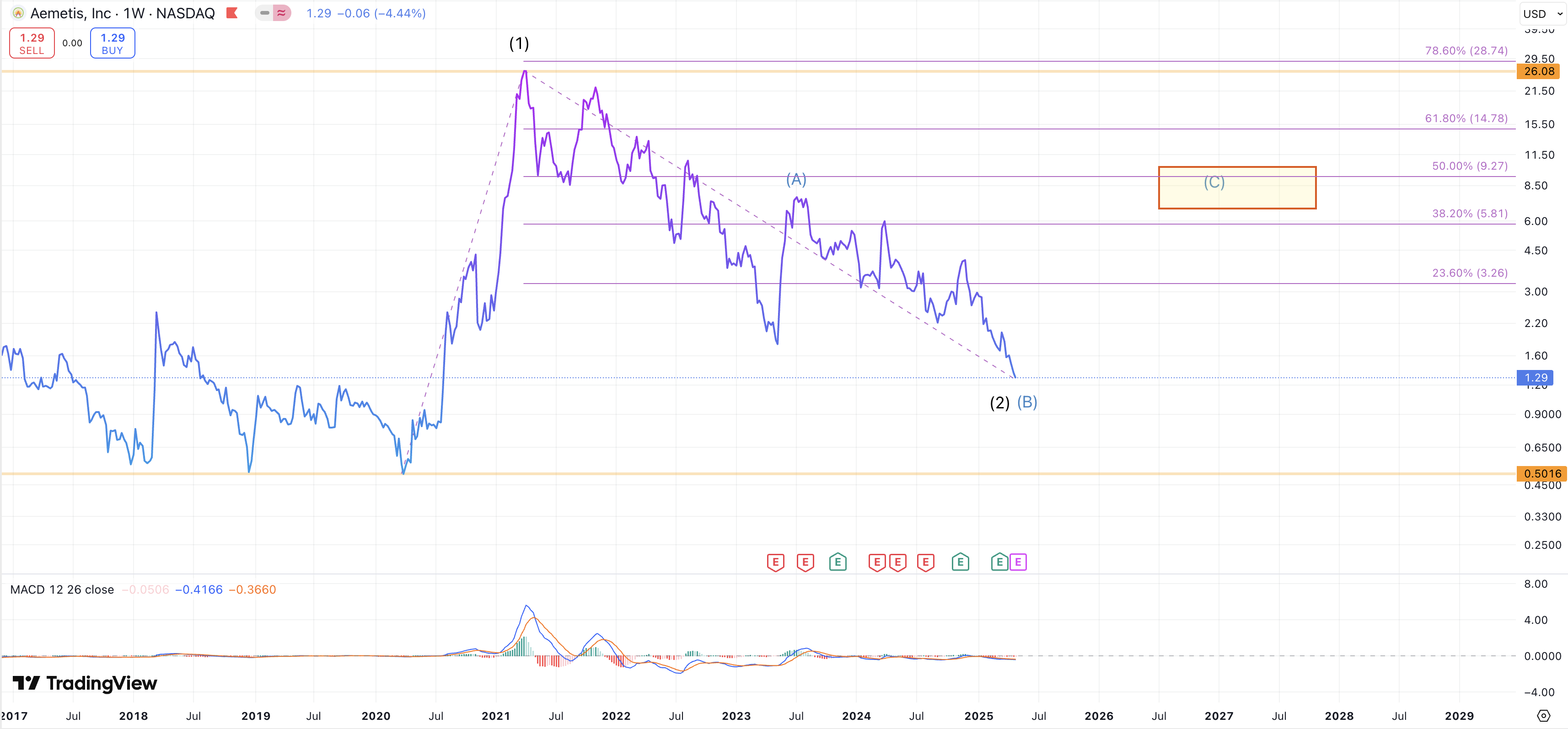
While technical analysis on a very small-cap might has low forecasting value, here is nonetheless an Eliott Wave count on the log chart of $AMTX.
Aemetis has been experiencing a protracted correction since the 2021 parabolic surge that took the price from sub $1 to north of $26, and the stock price is now making a 4-year low near $1.30.
Any counter-trend move could take the price anywhere in the first $4-5 price cluster, and to the $10-12 second cluster above (yellow box), in a matter of months. We want a break-out above the first and then second cluster for continuation higher. With sufficient catalysts lining up in 2025 and 2026, we think there is a decent probability for the price to make this move.
Other similar investing ideas
Gevo, Inc. (GEVO)
Gevo is a renewable fuels and chemicals company focused on developing and commercializing technology for the production of low-carbon, sustainable fuels and chemicals from renewable resources. They are very similar to Aemetis, except they are located in South Dakota (for a SAF plant) and Minnesota for an ethanol plant.
Gevo has no international presence like Aemetis (India subsidiary).
Gevo marketcap is over 3X Aemetis marketcap.
Conclusion
The bull thesis resides on whether Aemetis can achieve its 5-year plan defined by the management, and reach profitability within a reasonable timeframe, escaping bankruptcy or heavily diluting the shareholders.
We have speculated on what we think are the main market fears about the plan and have added counter-arguments to most of those.
While there is a non-negligible probability that some of those fears and delays could materialize, the risk-reward still makes the bet compelling in our opinion.
We estimate the current assets of the company minus the debt to be worth $1B+, and the fair share price to be $11. At a $1.29 share price, the company is essentially “free”. We view the current price as mispriced and a great contrarian pick, and we have initiated a long position.
Whether or not you agree with our view, we hope this article gave some materials to understand more about this trend of renewable fuels. Let us know what you think in the comments.
I like how you covered the political implications of the Trump presidency, interesting take. I'm a bit concerned however with being too early here, especially if we are heading to a recession, which is also my base case.
Appreciate the deep dive, but I'm still not convinced. A 20x plan from a company that's missed revenue targets, heavily indebted, and reliant on regulatory tailwinds is a high hurdle. Id want to see SAF plant construction actually begin before even thinking of a long position. Too many "ifs" here for my folio
Love the contrarian stance, and I agree this feels mispriced. But the financing risks are real, and I'm concerned about more dilution. I might start a small position. Will follow progress on the EB-5 raise or a JV on SAF